
Copyright: © 2026 by the authors. Licensee: Pirogov University.
This article is an open access article distributed under the terms and conditions of the Creative Commons Attribution license (CC BY).

OPINION

Modern hygienic approaches to assessing the compliance of specialized food products

Setko AG1 , Novokshanova AL2 , Yuskinа ON1
About authors

1 Erisman Federal Scientific Center of Hygiene of the Federal Service for Surveillance on Consumer Rights Protection and Human Wellbeing, Mytishchi, Russia

2 Federal Research Center for Nutrition, Biotechnology and Food Safety, Moscow, Russia

Correspondence should be addressed: Olga N. Yuskinа
Semashko, 2, Mytishchi, Moscow Region, 141014, Russia; ur.gcnf@NO.aniksuY

About paper

Author contribution: Setko AG — editing, material acquisition, analysis, and processing; Novokshanova AL — editing, concept and design of the analytical review, material acquisition and analysis; Yuskinа ON — editing, material collection, literature data processing; all authors — approval of the final version of the article, responsibility for integrity of all parts of the article.
Received: 2026-01-20 Accepted: 2026-05-13 Published online: 2026-06-24
|
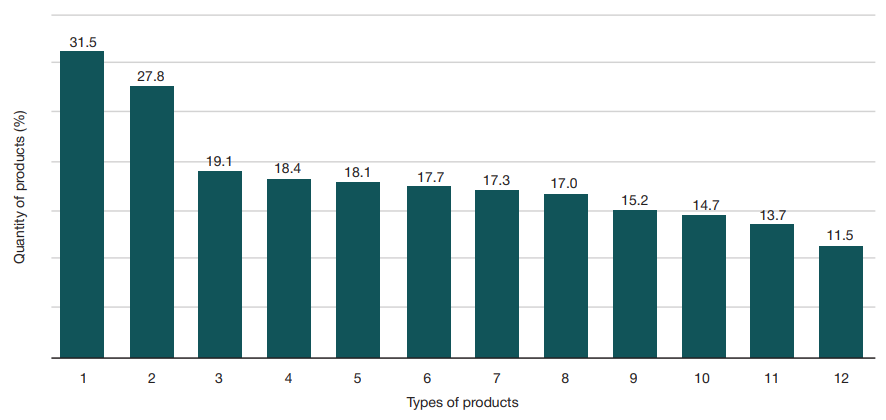
Fig. 1. The number of contaminated samples with the detection of undeclared substances by product group in the RF in 2023, % [1]: 1 — SFPs, including baby food and dietary supplements; 2 — fish, non-fish fisheries and products derived from them; 3 — meat and meat products; 4 — poultry, eggs and products of their processing; 5 — honey and bee products; 6 — sugar and confectionery; 7 — grain (seeds); 8 — fruit and vegetable products; 9 — packaged drinking water; 10 — fat and oil products; 11 — beverages; 12 — milk and dairy products
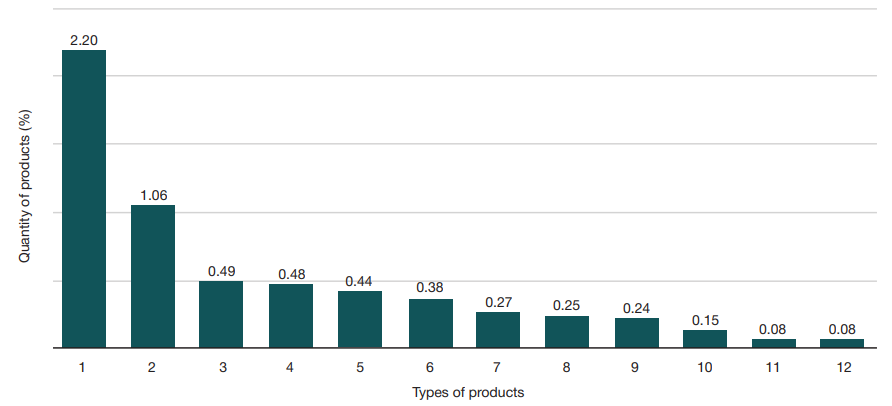
Fig. 2. The number of samples exceeding acceptable levels of contaminants by product group in the RF in 2023, % [1]: 1 — grain (seeds); 2 — SFPs, including baby food and dietary supplements; 3 — meat and meat products; 4 — fruit and vegetable products; 5 — fish, non-fish fisheries and products derived from them; 6 — packaged drinking water; 7 — milk and dairy products; 8 — poultry, eggs and products of their processing; 9 — honey and bee products; 10 — sugar and confectionery; 11 — fat and oil products; 12 — beverages