Copyright: © 2025 by the authors. Licensee: Pirogov University.
This article is an open access article distributed under the terms and conditions of the Creative Commons Attribution license (CC BY).

ORIGINAL RESEARCH

Comparison of uterine body cancer incidence among women living in environmentally disadvantaged areas (2000−2019)

About authors

1 Bryansk State Technical University, Bryansk, Russia

2 Pirogov Russian National Research Medical University, Moscow, Russia

Correspondence should be addressed: Anna E. Kryukova
Boulevard 50 let Oktyabrya, 7, Bryansk, 241035, Russia; ur.kb@annaavokuyrk

About paper

Acknowledgement: the authors thank A.I. Maklashova, Chief Medical Officer at the Bryansk Regional Oncological Dispensary, for providing anonymized statistical information on the incidence of endometrial cancer in women in the cities and districts of the Bryansk region for the period from 2000 to 2019.

Author contribution: Kryukova AE ― literature search, statistical processing, authoring, editing, and discussion of the article; Korsakov AV ― analysis of literary data, concept and design of the study, interpretation of the results, approval of the final version of the article; Troshin VP ― data analysis and interpretation, authoring, editing, and discussion of the article; Milushkina OYu ― analysis of literary data, analysis and interpretation of data, editing and discussion of the article; Pivovarov YuP, Korolik VV ― analysis and interpretation of data, editing and discussion of the article.

Compliance with ethical standards: the study used anonymized statistical information on the incidence of UBC in the Bryansk region in 2000–2019.
Received: 2025-04-18 Accepted: 2025-10-16 Published online: 2025-12-22
|
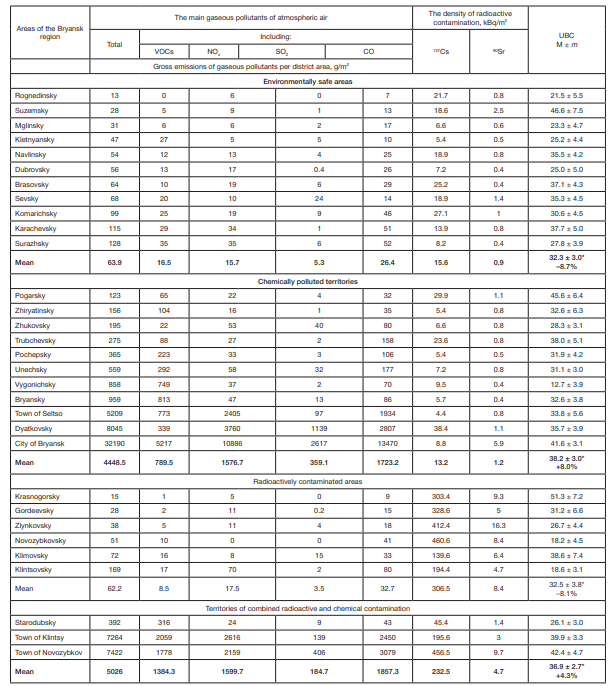
Table 1. Territories of the Bryansk region grouped by the degree of chemical, radioactive, and combined contamination and by the incidence of primary UBC among women aged 18–80 years (per 100,000 population) (2000–2019) [19]
Note: * — the difference (in %) from the all-Russian indicator of primary incidence (2000–2019).
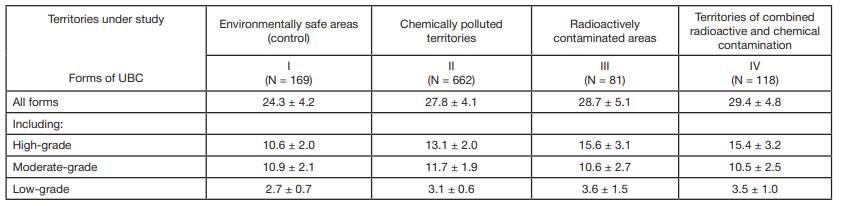
Table 2. Comparative assessment of the primary incidence rates of high-, moderate-, and low-grade forms of UBC among women aged 41–60 living in areas of the Bryansk region with varying environmental conditions, 2000–2019 (per 100,000 population)
Note: the differences between the groups by the areas are insignificant at p > 0.05.
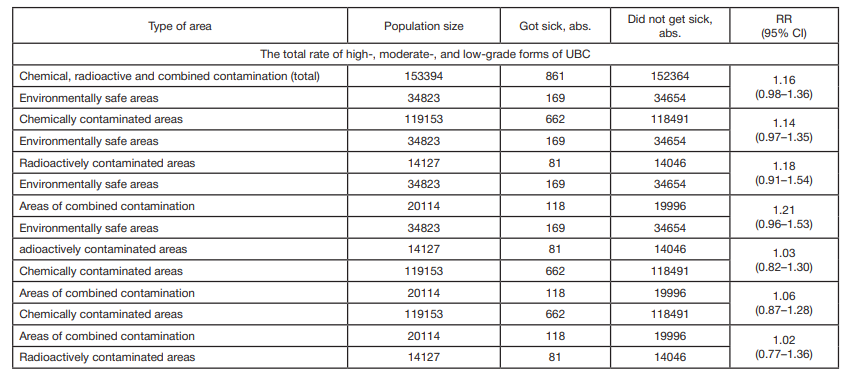
Table 3. Relative risk of the primary incidence of high-, moderate-, and low-grade forms of UBC among women aged 41–60 living in areas of the Bryansk region with varying environmental conditions, 2000–2019 (per 100,000 population)
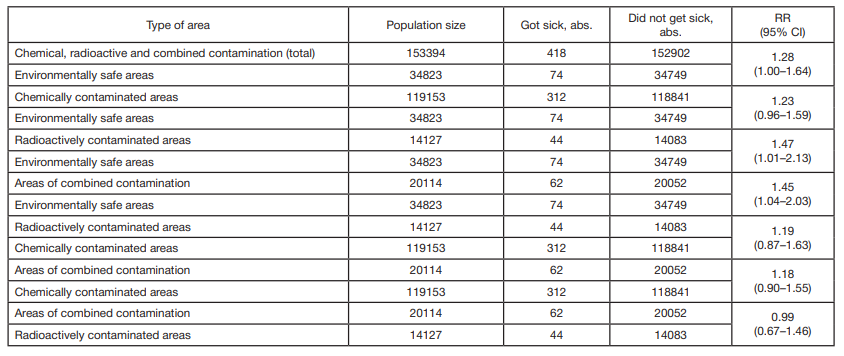
Table 4. Relative risk of primary incidence rates of high-grade forms of UBC among women aged 41–60 living in areas of the Bryansk region with varying environmental conditions, 2000–2019
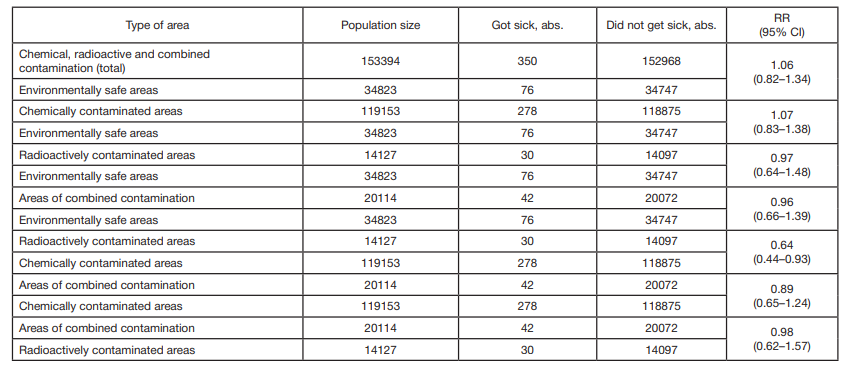
Table 5. Relative risk of primary incidence of moderately differentiated forms of UBC among women aged 41–60 living in areas of the Bryansk region with varying environmental conditions, 2000–2019
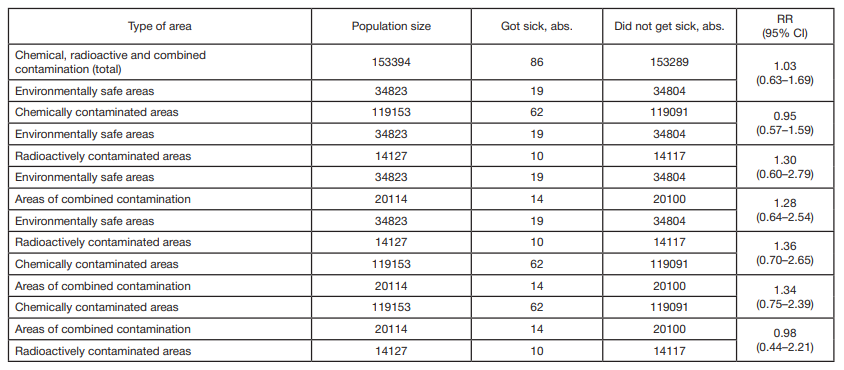
Table 6. Relative risk of primary incidence rates of low-grade forms of UBC among women aged 41–60 living in areas of the Bryansk region with varying environmental conditions, 2000–2019