Copyright: © 2025 by the authors. Licensee: Pirogov University.
This article is an open access article distributed under the terms and conditions of the Creative Commons Attribution license (CC BY).

ORIGINAL RESEARCH

Analysis of infectious disease rate in children of different ages aimed at developing hygiene education programs

About authors

Pirogov Russian National Research Medical University, Moscow, Russia

Correspondence should be addressed: Vasily P. Krylov
Gostinichnaya, 12, bld. 6, Moscow, 127106, Russia; moc.liamg@77.enur.ylisav
Received: 2025-09-07 Accepted: 2025-12-11 Published online: 2025-12-30
|
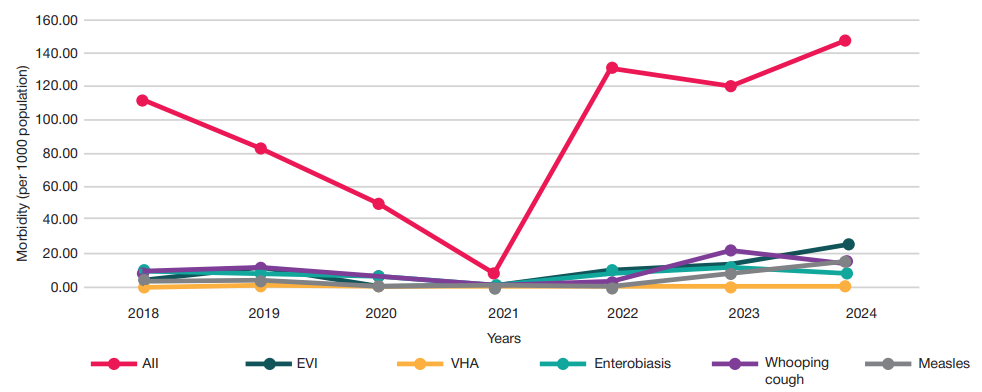
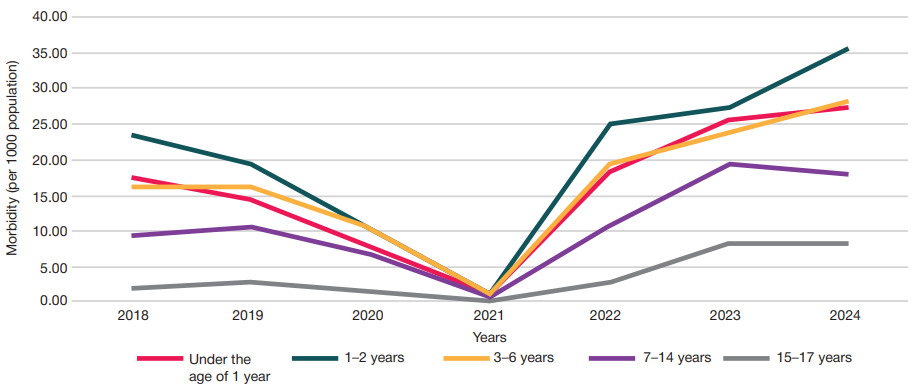
Fig. 1. Infectious morbidity rates in pediatric population of the ZAO of Moscow for the years 2018–2024 (7-year average)
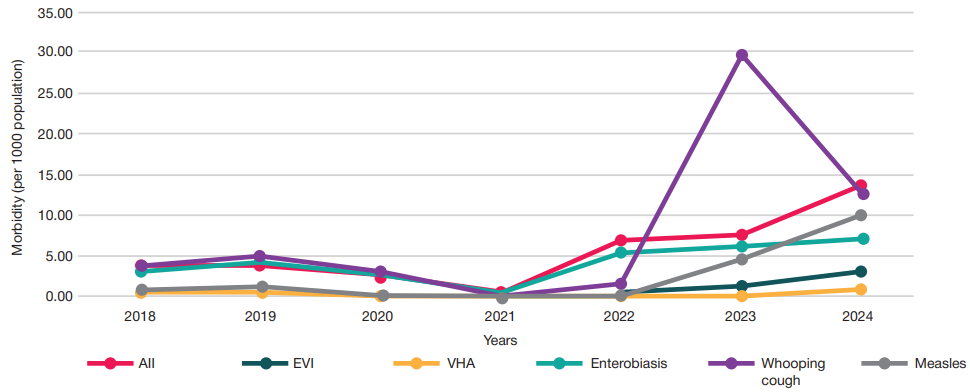
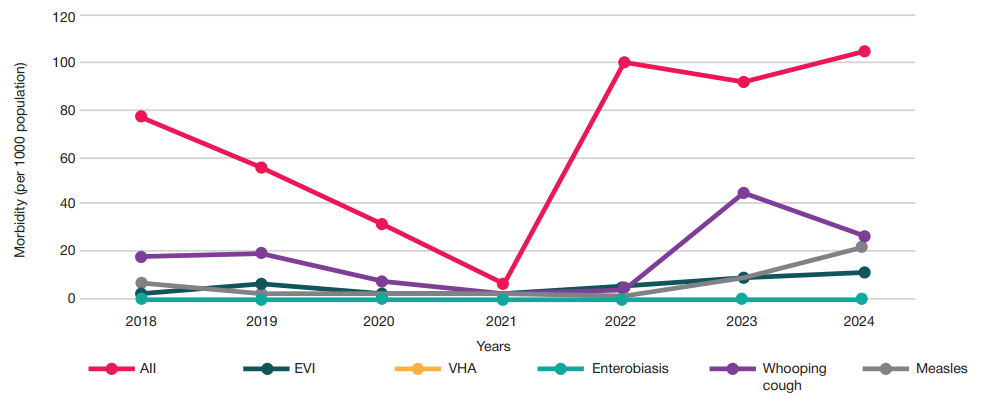
Fig. 2. Infectious morbidity rates in children under the age of one year in the ZAO of Moscow for the years 2018–2024
Note: AII — acute intestinal infections; EVI — enterovirus infection; VHA — viral hepatitis А.
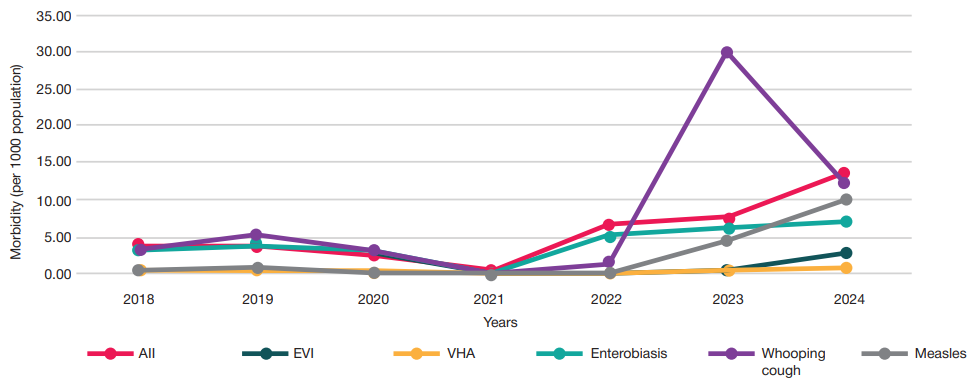
Fig. 3. Infectious morbidity rates in children aged 1−2 in the ZAO of Moscow for the years 2018–2024
Note: AII — acute intestinal infections; EVI — enterovirus infection; VHA — viral hepatitis А.
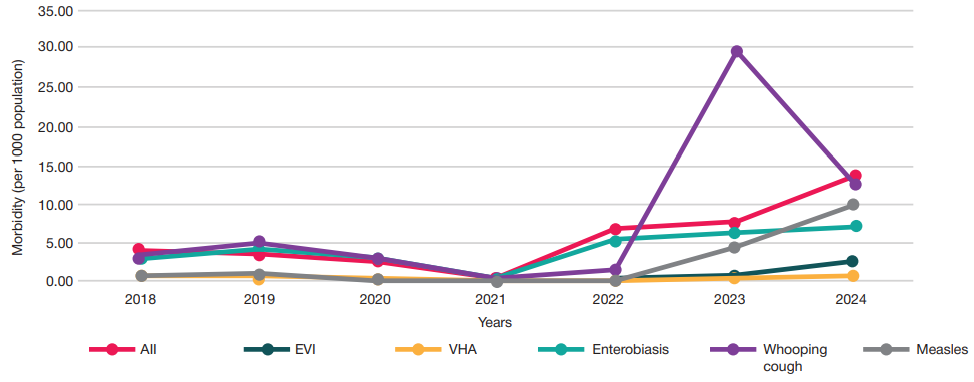
Fig. 4. Infectious morbidity rates in children aged 3−6 in the ZAO of Moscow for the years 2018–2024
Note: AII — acute intestinal infections; EVI — enterovirus infection; VHA — viral hepatitis А.
Fig. 5. Infectious morbidity rates in children aged 7−14 in the ZAO of Moscow for the years 2018–2024
Note: AII — acute intestinal infections; EVI — enterovirus infection; VHA — viral hepatitis А.
Fig. 6. Infectious morbidity rates in children aged 15−17 in the ZAO of Moscow for the years 2018–2024
Note: AII — acute intestinal infections; EVI — enterovirus infection; VHA — viral hepatitis А.